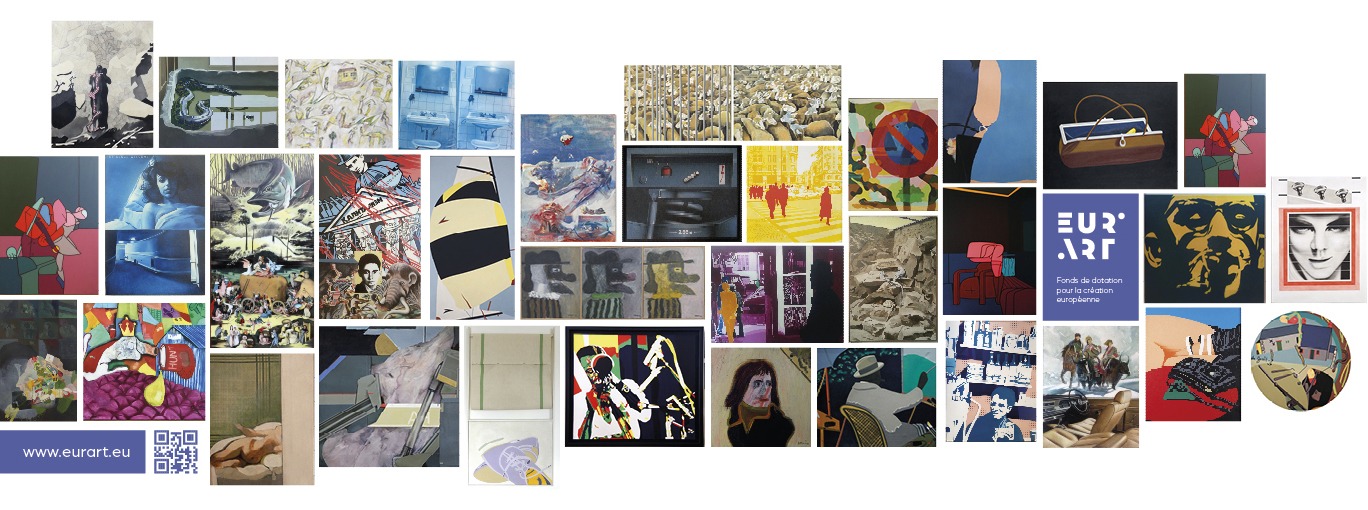
Eur’Art holds a collection of Narrative Figuration works that brings together some forty pieces representative of the movement, as defined by the two Parisian exhibitions (1964–1977).
Exhibition
Contemporary Perspectives on Narrative Figuration
An exhibition curated by Évelyne Artaud, art critic and artistic director of La Fabrique Centre d’Art, featuring Eur’Art’s Narrative Figuration collection alongside works from the collections of partner museums.
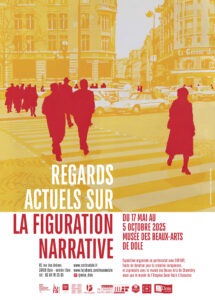
- DOLE MUSEUM OF FINE ARTS: 16 May to 24 November 2025
CHAMBÉRY MUSEUM OF FINE ARTS: 19 December 2025 to 30 March 2026
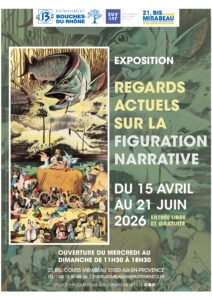
ESPACE MIRABEAU, AIX-EN-PROVENCE GENERAL COUNCIL: 15 April to 21 June 2026
COTIGNAC ART CENTRE: July/August 2026
HOSPICE SAINT-ROCH MUSEUM, ISSOUDUN: 25 September to 27 February 2027
Narrative Figuration – DOLE Press File

Partners

Narrative Figuration
The origins of this movement, which emerged in the early 1960s across various European countries, stemmed from the reintroduction into art of the human figure —“forbidden” since the images of the Holocaust—and from a rejection of the abstraction that dominated the artistic scene at the time.
The 1960s brought a flood of colour images. At the time, these were a sign of modernity. Previously, illustrations and television had been black and white. From the use of these images, supported by new tools such as the episcope, Pop Art—and later Narrative Figuration—emerged.
The aesthetics of Pop Art (and of New Realism) place the object or image from popular culture at the center, rather than art itself, which until then had been considered the highest form of culture.
Narrative Figuration, however, continued to maintain a concern for painting as a practice. The subject of the works changed, but not their mode of production. It moved away from a purely observational art and reintroduced temporality into painting in order to tell stories in which the boundaries between reality and imagination fade.
At the first exhibition, Mythologies Quotidiennes in 1964 in Paris—considered the founding exhibition of this pictorial movement—around ten of the 34 artists were French; most of the others came from eleven other European countries. The critic Gérald Gassiot-Talabot presented the idea of a creative subjectivism that he described as a “European characteristic.”
For the second exhibition, in 1977, artists from 17 of the 28 European countries of the time were invited.
These were two remarkable examples of artistic and cultural exchange and emulation across Europe.
Dominique Defontaines
Founding President
Memory and Creation
Why take on the challenge of hosting a historical collection when our mission is to support contemporary European creation?
It is an invitation to continuity and dialogue. European artistic and cultural exchanges do not take place solely in the present. The democracy of our European culture also calls for the voices of those who came before us. Their legacy lies in the timelessness of their work, which transcends the interests and even the personal or collective commitment of a particular era. It is the voice of suspended time, of a fiction or a tale from the beyond, bearing hope and faith in the dignified and free human being.
As contemporary artists, we take on the task of remembrance. How can we build a civilisation upon its own tragedies and weaknesses? To create in spite of everything. To view art through the lens of freedom, authenticity and personal creation—which creates and shares, and which, through continuity, connects us via memory to history and via imagination to the building of the future.
To cultivate the imagination and reflection of a European culture eager for meaning—is this not the best form of renewable energy?
Marie Kopecká Verhoeven
Director

